Posted on Jun 10, 2026 in
NEWSWORTHY
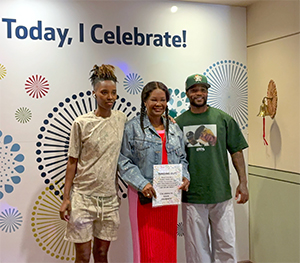
Queenie and her kids after she rung the bell following her last radiation appointment in May!
One out of every 18 Americans is a cancer survivor. In recognition of National Cancer Survivors Month this June, Houston Methodist is highlighting the story of Queenie Freeman, a 61-year-old breast cancer survivor who rang the ceremonial bell this spring after her last radiation treatment at Houston Methodist Sugar Land Hospital’s Neal Cancer Center. Freeman was accompanied by her husband, rapper Bun B, and her children.
For the last 25 years, Freeman has received routine, annual mammograms and always had clear results. To her surprise last summer, she received a call to return to the hospital for additional imaging. Despite having no symptoms, Freeman was diagnosed with stage 3 invasive ductal carcinoma that had spread to her lymph nodes.
“I had no warning signs at all; no pain, no weight loss, nothing,” Freeman said. “I was terrified because I thought cancer was a death sentence. The word ‘invasive’ was the scariest part of it all. My doctors at Houston Methodist told me this would be a battle, but one I could fight if I wanted.”
Freeman was referred to the Fast Track Program at Houston Methodist Sugar Land Hospital, where she met with her care team who provided a comprehensive, personalized treatment plan. Within days, she began chemotherapy.
Houston Methodist Sugar Land is the only hospital in Fort Bend County offering a Fast Track Program, an expedited process that helps patients receive a diagnosis sooner and meet with an oncologist team within days, easing their anxiety during a stressful time.
“From the online cancer groups I’m in, I’ve heard it can take up to 2-3 months sometimes to get biopsies and MRIs scheduled,” Freeman said. “I got called back within days. I’ll never forget that.”
“One of the biggest benefits of our Fast Track Program is speed,” said Dr. Sindhu Nair, breast oncologist at Houston Methodist Sugar Land Hospital. “Faster diagnoses allow us to begin treatment sooner, which can significantly improve patient outcomes. Freeman’s case is a strong example of why time matters when it comes to cancer.”
After completing six rounds of chemotherapy, Freeman underwent a double mastectomy with reconstruction in December 2025. Pathology results showed no remaining cancer cells. As an added precaution, Freeman also completed 30 rounds of radiation therapy, and as of late May 2026, has been declared cancer free.
Although genetic testing revealed her cancer was not inherited, Freeman says breast cancer has affected several people close to her. “Several of my friends and one of my cousins were diagnosed with aggressive forms of breast cancer. That’s why I always stayed on top of my mammograms,” Freeman said. “I only wish I had asked more questions.”
Mammogram results over the past five years showed she had dense breast tissue, a factor that can make cancer more difficult to detect. Freeman’s experience underscores a critical message that breast cancer can develop quickly and without any noticeable symptoms.
Today, Freeman is embracing what she calls her “new purpose” by donating her breast tissue to science to help the next person and sharing her story to inspire and raise awareness this Cancer Survivors Month. “I didn’t just survive this. I learned from it,” she said. “If my experience encourages even one person to get screened, it’s worth it.”
National Cancer Survivors Month recognizes the estimated 18.6 million Americans who have battled and survived cancer. By 2035, that number is projected to exceed 22 million, 5.3 million of which are breast cancer survivors, according to the American Cancer Society.
From diagnosis through treatment and beyond, this observance raises awareness of the ongoing physical and emotional challenges survivors may experience. Cancer survivorship has grown over the last several years due to screening improvements, early detection, advances in targeted therapies, and comprehensive treatment approaches. Despite the progress, survivors often face long-term and late effects, including chronic pain, an increased risk of recurrence or secondary cancers, mental health challenges and financial burdens.
For more information about Houston Methodist, visit our newsroom at Newsroom | Houston Methodist.